Blog
China LED High Bay Light Factory Guide: How to Find the Right Supplier for Warehouse Projects

China LED High Bay Light Factory Guide: How to Find the Right Supplier for Warehouse Projects
Finding a reliable China LED high bay light factory is not simply about comparing prices. For warehouse owners, lighting contractors, distributors, and industrial project buyers, choosing the wrong manufacturer can result in poor illumination, excessive maintenance costs, product failures, and project delays.
China has become one of the world's major manufacturing centers for industrial LED lighting. Thousands of factories and trading companies offer LED high bay lights, including UFO high bay lights, linear high bay lights, and customized industrial lighting solutions.
However, not every supplier has the engineering capabilities, quality control systems, or production experience required for demanding warehouse projects.
So, how can B2B buyers identify a reliable manufacturer and avoid expensive sourcing mistakes?
This guide explains 10 essential factors to check before selecting a Chinese LED high bay light supplier.
1. Understand Your Warehouse Lighting Requirements First
Before contacting manufacturers, define your project requirements.
Different warehouses have different lighting requirements depending on ceiling height, shelving layout, working activities, and operating conditions.
For example:
| Warehouse Type | Typical Ceiling Height | Recommended Lighting |
|---|---|---|
| Small Warehouse | 4–6 meters | 100W–150W LED High Bay |
| Medium Warehouse | 6–9 meters | 150W–200W LED High Bay |
| Large Distribution Center | 9–12 meters | 200W–240W LED High Bay |
| High-Rack Warehouse | 12–18 meters or higher | 240W–400W LED High Bay |
Note: These are preliminary product-selection ranges, not final lighting design recommendations. Actual wattage and fixture quantities should be determined through a lighting simulation.
Buyers should consider:
Required illuminance (lux).
Ceiling mounting height.
Beam angle and light distribution.
Uniformity requirements.
Color temperature (CCT).
Color rendering index (CRI).
Operating hours per day.
Emergency lighting requirements.
Buyer Pain Point:
Many buyers select LED high bay lights based only on wattage. However, two 200W fixtures can have significantly different light outputs and distribution patterns.
Our Recommendation:
Ask the factory to provide a Dialux or Relux lighting simulation based on your warehouse layout. This helps determine the correct wattage, installation spacing, and fixture quantity before ordering.
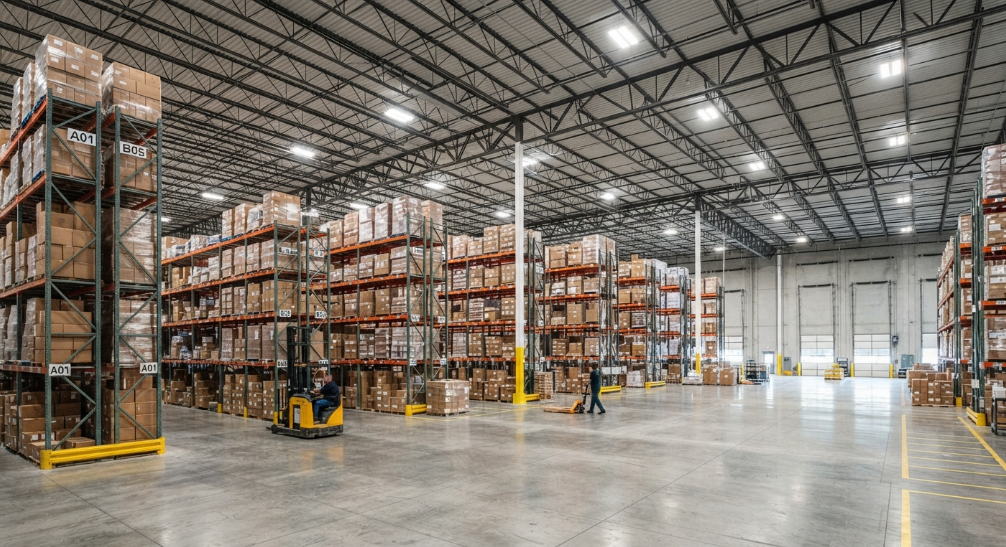
LED high bay lighting installation in a modern industrial warehouse.
2. Check the Factory's Real Manufacturing Capabilities
One of the biggest sourcing risks is confusing a trading company with an actual manufacturer.
A reliable LED high bay light factory should have the necessary production capabilities to control product quality, delivery schedules, and manufacturing costs.
Important manufacturing processes include:
Aluminum housing production or die casting.
LED PCB assembly.
LED driver installation.
Thermal management and heat dissipation.
Optical lens and reflector assembly.
Electrical testing.
Aging testing.
Final product inspection.
Not every factory needs to own every production process. However, buyers should understand which processes are performed in-house and which are outsourced.
Questions to Ask the Supplier:
Do you manufacture the aluminum housing in-house?
Do you have your own assembly and testing lines?
Can you provide factory production videos?
What is your monthly production capacity?
Can you support OEM and ODM projects?
Buyer Pain Point:
A supplier may offer an attractive price but outsource most manufacturing processes. This can create communication problems, inconsistent quality, and longer delivery times.
Our Recommendation:
Request a virtual factory tour or arrange an on-site audit before placing large-volume orders.
3. Don't Choose a High Bay Light Based Only on Lumen Claims
Lumen output is one of the most important specifications when purchasing industrial LED lighting.
However, some suppliers advertise extremely high luminous efficacy figures without providing reliable test reports.
For example:
| Specification | Product A | Product B |
|---|---|---|
| Power | 200W | 200W |
| Claimed Efficiency | 150 lm/W | 190 lm/W |
| Claimed Lumen Output | 30,000 lm | 38,000 lm |
| Actual Performance | Requires Verification | Requires Verification |
A higher claimed lumen output does not automatically mean better lighting performance.
Buyers should request:
LM-79 test reports.
Integrating sphere test results.
LED chip specifications.
LED driver specifications.
Complete luminaire luminous efficacy.
Power consumption and power factor data.
It is also important to distinguish LED chip efficacy from complete luminaire efficacy.
Buyer Pain Point:
Some buyers receive samples that look bright but discover that actual performance is lower than the advertised specifications.
Our Recommendation:
Ask for independent test reports or third-party verification, especially for large warehouse lighting tenders.
4. Evaluate Heat Dissipation and Thermal Management
Heat management directly affects the reliability and operating life of LED high bay lights.
Warehouse lighting fixtures often operate for 10–16 hours per day. Poor thermal design can accelerate LED degradation and increase driver failure rates.
A professional manufacturer should pay attention to:
Aluminum Housing Design
Aluminum housings provide a pathway for heat transfer from LED boards to the surrounding air.
Heat Sink Structure
A suitable fin structure increases the heat dissipation surface area.
Thermal Management
The LED PCB, thermal interface material, housing, and driver arrangement should be properly designed.
Temperature Testing
The manufacturer should conduct temperature-rise testing under defined operating conditions.
Buyers should request information about:
LED junction temperature estimation.
LED case temperature.
Driver operating temperature.
Thermal test reports.
Ambient operating temperature range.
Buyer Pain Point:
An inexpensive fixture may use a lightweight housing with insufficient thermal management. It might pass a short initial test but experience premature failures after continuous operation.
Our Recommendation:
Do not evaluate the housing only by appearance or weight. Request thermal test data and compare the actual operating temperatures.
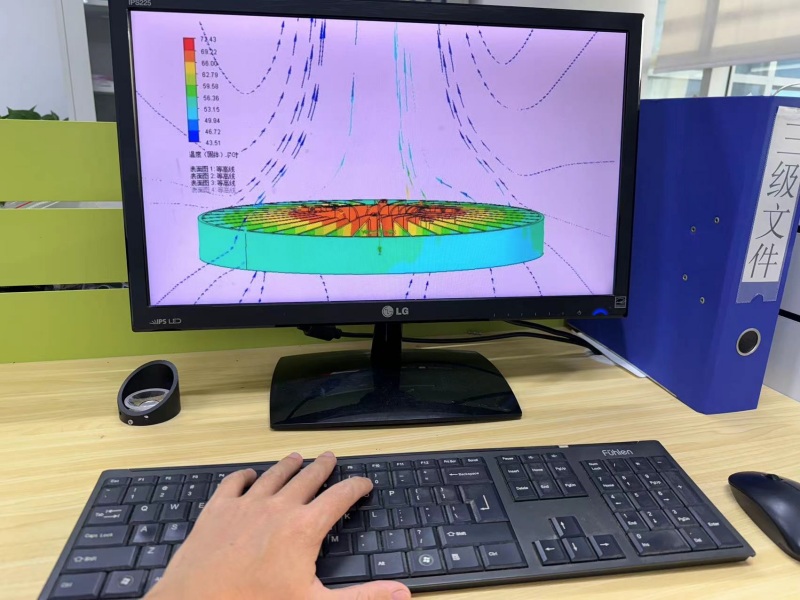
Aluminum heat sink and thermal management design of an LED high bay light.
5. Check LED Driver Quality and Electrical Performance
The LED driver is another critical component.
Even if the LED chips are high quality, an unreliable driver can cause flickering, unstable output, or complete fixture failure.
For warehouse projects, buyers should pay attention to:
Driver manufacturer and model.
Input voltage range.
Power factor (PF).
Total harmonic distortion (THD).
Surge protection.
Over-temperature protection.
Short-circuit protection.
Dimming compatibility.
For projects with unstable electrical conditions or outdoor industrial environments, surge protection deserves particular attention.
Common driver brands used in professional LED lighting include Mean Well, Inventronics, and Sosen.
However, the actual driver model and its compatibility with the fixture should always be verified.
Buyer Pain Point:
Some suppliers advertise well-known driver brands but change to lower-cost alternatives during mass production.
Our Recommendation:
Specify the approved driver brand and model in the purchase order. Require written approval before any component substitution.
6. Verify Certifications for Your Target Market
Certification requirements differ between countries and regions.
A product suitable for one market may not meet the requirements of another.
Before ordering, confirm which standards and approvals apply to your destination market.
| Target Market | Common Requirements to Check |
|---|---|
| USA | UL or ETL listing, FCC where applicable |
| Canada | CSA or cUL/cETL certification |
| European Union | CE, EMC, RoHS and applicable safety requirements |
| UK | Applicable UK product compliance requirements |
| Australia | RCM requirements where applicable |
| Middle East | Relevant national conformity requirements |
Important documents may include:
CE EMC test report.
CE LVD test report.
RoHS documentation.
UL or ETL certification.
LM-79 photometric report.
LM-80 and TM-21 LED lifetime documentation.
Remember that LM-79, LM-80, and TM-21 serve different purposes. They should not be treated as interchangeable product certifications.
Buyer Pain Point:
Some suppliers provide certificates belonging to different product models or components rather than the exact fixture being purchased.
Our Recommendation:
Check the certificate holder, product model, factory information, applicable standards, and certification database where available.
Never rely only on a PDF certificate sent by a salesperson.
7. Compare UFO High Bay Lights and Linear High Bay Lights
Different warehouse layouts require different lighting designs.
The two common industrial lighting types are UFO high bay lights and linear high bay lights.
UFO LED High Bay Lights
UFO high bay lights feature a compact circular design.
Advantages:
Compact structure.
Easy installation.
Efficient heat dissipation design.
Suitable for open warehouse spaces.
Various beam angle options.
Common applications:
General warehouses.
Manufacturing workshops.
Logistics centers.
Sports facilities.
Linear LED High Bay Lights
Linear high bay lights have an elongated housing design.
Advantages:
Suitable for long aisles.
Better integration with shelving layouts.
Flexible optical distribution.
Suitable for continuous lighting arrangements.
Common applications:
High-rack warehouses.
Supermarkets.
Distribution centers.
Industrial production lines.
Buyer Pain Point:
Choosing the wrong light distribution can create dark areas between shelves or unnecessary glare for warehouse workers.
Our Recommendation:
Choose the fixture based on the warehouse layout rather than simply selecting the most popular product.
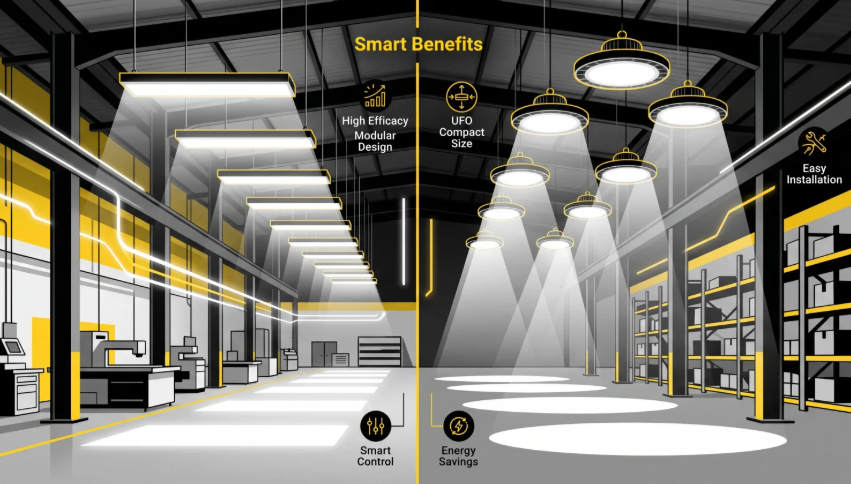
Comparison between UFO LED high bay lights and linear LED high bay lights.
8. Evaluate Customization and OEM/ODM Capabilities
For lighting distributors, project contractors, and established brands, standard products may not always meet specific market requirements.
A manufacturer with OEM and ODM capabilities can provide more flexible solutions.
Potential customization services include:
Customized aluminum housing.
Private-label logo printing.
Customized packaging.
Different beam angles.
Customized power and lumen output.
Dimming options such as 0–10V and DALI.
Motion sensor integration.
Emergency battery backup options.
Customized installation accessories.
For larger projects, ask whether the factory can support product development, prototype production, tooling development, and mass production.
Buyer Pain Point:
Some suppliers can modify labels and packaging but lack the engineering team to develop customized products.
Our Recommendation:
If customization is important, evaluate the supplier's engineering team, prototype capabilities, tooling experience, and previous OEM/ODM projects.
9. Compare Total Purchasing Costs, Not Just Unit Prices
Price is important, especially for distributors and large warehouse projects.
However, the cheapest product is not always the most economical choice.
Buyers should calculate the total cost of ownership.
Consider the following:
| Cost Factor | What to Check |
|---|---|
| Product Price | Fixture price and included accessories |
| Shipping | Carton dimensions, weight, and container loading |
| Installation | Mounting method and installation time |
| Energy | Actual power consumption |
| Maintenance | Expected driver and fixture replacement costs |
| Warranty | Warranty period and replacement policy |
| Compliance | Testing and certification costs |
For example, a more efficient LED high bay light may have a higher purchase price but reduce electricity consumption over several years.
Buyer Pain Point:
A supplier may offer a low quotation but exclude accessories, dimming controls, or other necessary components.
Our Recommendation:
Request a detailed quotation with clear specifications, accessories, packaging, warranty terms, and delivery conditions.
Compare products using the same technical specifications.
10. Check Quality Control, Warranty, and After-Sales Support
A reliable LED high bay light manufacturer should have a clear quality control process.
Before mass production, ask about:
Incoming material inspection.
LED driver inspection.
LED PCB inspection.
Assembly quality control.
Aging testing.
Electrical safety testing.
Final product inspection.
Batch traceability.
For large orders, buyers should also discuss pre-shipment inspection.
What About Warranty?
Professional industrial LED lighting suppliers commonly offer warranties of 3–5 years, depending on the product configuration and commercial terms.
However, the warranty period alone does not guarantee good after-sales service.
Clarify:
What components are covered?
What happens if a fixture fails?
Who pays replacement shipping costs?
How are defective products verified?
Is technical support available after installation?
Buyer Pain Point:
A supplier may promise a five-year warranty but provide no practical replacement procedure when products fail.
Our Recommendation:
Get the warranty policy in writing before placing an order. Ask for previous project references and examples of after-sales support.
11. Bonus: Use a Supplier Evaluation Checklist Before Ordering
To make supplier comparisons easier, B2B buyers can use the following evaluation table.
| Evaluation Item | Importance |
|---|---|
| Actual Factory Manufacturing Capability | High |
| Product Photometric Performance | High |
| LED Driver Quality | High |
| Thermal Management | High |
| Required Market Certifications | High |
| Production Quality Control | High |
| OEM/ODM Capabilities | Medium–High |
| Delivery Capacity | High |
| Warranty and After-Sales Support | High |
| Competitive Total Cost | High |
We recommend requesting samples and conducting a factory audit before committing to large-volume orders.
A professional supplier should be willing to answer technical questions and provide supporting documentation.
Conclusion: Choose a Manufacturing Partner, Not Just a Cheap Supplier
Finding the right China LED high bay light factory requires more than comparing quotations.
For warehouse lighting projects, buyers should focus on manufacturing capabilities, verified lumen output, thermal management, driver quality, certifications, customization, and long-term after-sales support.
A reliable manufacturer should be able to provide not only competitive products but also engineering support, consistent production quality, and dependable delivery.
For lighting distributors, electrical contractors, and procurement managers, building a long-term partnership with the right Chinese manufacturer can reduce sourcing risks, improve project performance, and create better business opportunities.
If you are looking for a Chinese LED lighting manufacturer for industrial and warehouse lighting projects, Oleder offers a range of LED lighting manufacturing and customization solutions.
Visit Oleder to explore its lighting products and manufacturing capabilities.
Frequently Asked Questions (FAQ)
1. How do I find a reliable LED high bay light factory in China?
Start by checking the company's manufacturing capabilities, product specifications, certifications, quality control procedures, and export experience. Request product samples, test reports, and a factory audit before placing a large order.
2. What is the best wattage for warehouse LED high bay lights?
Common options include 100W, 150W, 200W, 240W, and 300W. The correct wattage depends on ceiling height, required illuminance, beam angle, mounting position, and warehouse layout.
A professional lighting simulation is recommended.
3. What is the difference between UFO and linear LED high bay lights?
UFO high bay lights have a compact circular design and are suitable for general warehouse lighting. Linear high bay lights are better suited to long aisles, shelving systems, and specific industrial layouts.
4. What certifications should I request from a Chinese LED high bay light manufacturer?
Requirements depend on your target market. Common documents include CE, EMC, LVD, RoHS, UL, ETL, and LM-79 reports, where applicable. Always verify that the documents cover the exact product model.
5. Can Chinese LED high bay light factories provide OEM and ODM services?
Yes. Many manufacturers offer OEM and ODM services, including customized housing, wattage, optical design, driver configuration, packaging, and private labeling. More advanced factories may also provide product development, tooling, and prototype manufacturing.
6. How long should a quality LED high bay light last?
The expected lifetime depends on LED components, driver quality, operating temperature, and working conditions. Ask for LM-80 and TM-21 supporting data for LED package lifetime projections, along with the complete fixture warranty.
7. What is the typical MOQ for LED high bay lights from China?
MOQ varies by manufacturer and product model. Standard products may be available in relatively small quantities, while customized products may require higher MOQs depending on tooling, components, and packaging requirements.
8. Why should I choose a factory instead of a trading company?
Direct factory cooperation can improve communication with engineering and production teams, provide better customization flexibility, and simplify quality control. However, buyers should evaluate the actual manufacturing capabilities of each supplier rather than relying only on company descriptions.
About Oleder
Oleder is a Chinese LED lighting manufacturer providing lighting products and manufacturing solutions for international B2B customers.
For distributors, contractors, and industrial lighting project buyers, working with an experienced manufacturer can help improve product consistency and sourcing efficiency.
Author introduction

Author
Hey Guys ,My name is Royce O'young, the sales manager of Oleder Lighting. I have been in the LED lights industry for more than 16 years,have some experience in lighting design,
track light system configuration, and bidding technology support,and architecture inner decorating lighting advice.
If you are looking for assistance from industry professionals to help guiding you in your lighting process,feel free to reach out to our talented Oleder team .
Email: r.oyoung@oleder-lighting.com | Wechat/WhatsApp: +86159 2057 0517.
Recommended Products
CATEGORIES
CONTACT US
Contact: Royce O'young
Phone: 15920570517
Tel: 0086-20-37716973
Email: r.oyoung@oleder-lighting.com
Add: Room 335,#1 Xianke 1st Rd, Honglitronic Group,Huadu ,510890, Guangzhou,P.R.C.
 Send Email
 Royce O'young
 Sales
 WhatsApp