Blog
Everything About THD for LED Lights You Need to Know

Introduction
When you buy LED lights, you probably look at lumens (brightness), color temperature (warm or cool white), and wattage (energy use). But there’s a hidden technical spec on some datasheets that can impact your entire electrical system: THD, or Total Harmonic Distortion.
While it sounds complex, understanding THD can save you money, improve safety, and ensure cleaner power in your home or business. This guide breaks down everything you need to know about THD for LED lights in simple terms.
1. What is THD (Total Harmonic Distortion)?
In an ideal electrical system, the current flowing from the grid is a perfect sine wave. However, many modern electronics, including the power supplies (drivers) inside LED bulbs, disrupt this smooth flow.
THD is a measurement of how much an electrical device (like an LED) distorts the clean sine wave of the current it draws.
Low THD: The LED draws current in a way that closely matches the perfect sine wave. It’s "well-behaved" and efficient for the grid.
High THD: The LED draws current in sharp, irregular pulses. This creates "harmonic" frequencies that pollute the electrical system.
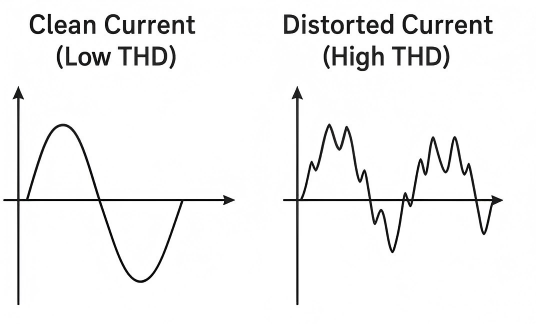
Side-by-side comparison of two sine waves.
Left: Labeled "Clean Current (Low THD)". Shows a smooth, regular wave.
Right: Labeled "Distorted Current (High THD)". Shows a jagged, irregular wave.*
2. Why Does THD Matter for LED Lights? It's Not Just About Light
You won't see the difference in the light output, but you might feel the effects elsewhere.
The "Bad Neighbor" Effect in Your Wiring:
Imagine many high-THD LED bulbs on the same circuit. Their distorted currents add up, leading to potential issues:
Overheating of Neutral Wires: In three-phase systems (common in offices/commercial buildings), harmonics can overload neutral wires, creating a fire risk.
Tripped Circuit Breakers: Harmonic currents can cause "phantom" loads that confuse sensitive breakers (like AFCI/GFCI), leading to nuisance tripping.
Reduced Efficiency: Harmonic distortion causes energy losses in transformers and wiring, slightly increasing your overall energy bill.
Interference with Sensitive Equipment: High THD can disrupt audio systems, medical equipment, and other precision electronics on the same circuit.
A simple infographic showing three consequences: 1) A warm, overloaded wire. 2) A tripped circuit breaker. 3) A "Noisy" signal on a speaker or radio.
3. What is a "Good" THD Rating for LED Lights?
THD is expressed as a percentage (%). A lower percentage is better.
<20% THD: Good for residential use. Most quality bulbs from reputable brands fall into this range. Minimal risk of issues in a home.
<10% THD: Excellent / Premium. Found in high-quality commercial-grade LEDs and bulbs from brands that prioritize power quality. Ideal for large installations.
>30% THD: Poor. Common in the cheapest, no-name LED bulbs. Using many of these together increases the risk of problems.
>100% THD: Yes, it's possible! This happens with extremely "peaky" current draw and indicates a very poorly designed driver.
Industry Standards:
ENERGY STAR certification for integral LED lamps requires THD ≤ 20% for lamps >5W.
Many commercial/utility rebate programs require THD < 10%.
Comparing THD levels:
*<10% (Green Bar): Premium/Commercial - "Excellent"*
*10-20% (Yellow Bar): Standard Quality - "Good"*
*20-35% (Orange Bar): Low Cost - "Fair/Potential Issues"*
*>35% (Red Bar): Very Poor - "Avoid"*
4. How to Find and Check the THD of Your LEDs
Check the Datasheet: This is the primary source. Look for "Total Harmonic Distortion (THD)" or "THD" under electrical specifications. It's often listed near power factor (PF).
Look on the Packaging (Less Common): Higher-end bulbs might list "Low THD" or a specific percentage as a selling point.
Beware of Missing Info: If a datasheet only lists "Power Factor" but not THD, it often (but not always) indicates a higher THD. A high Power Factor (e.g., >0.9) often correlates with low THD, but it's not a guarantee.
5. THD vs. Power Factor: What's the Difference?
People often confuse these two. Here’s the simple breakdown:
Power Factor (PF): Measures how effectively the bulb uses the current it draws. A low PF (e.g., 0.5) means you're paying for current that does no useful work (wasted). It's about efficiency and your electricity bill.
Total Harmonic Distortion (THD): Measures how cleanly the bulb draws current. High THD means it pollutes the electrical system. It's about power quality and system health.
They are related! A very low THD usually results in a high Power Factor. However, it's possible to have a decent Power Factor with moderate THD using correction circuits.
6. FAQs About THD and LED Lights
Q: Should I replace all my LEDs if they have high THD?
A: Not necessarily. For a few bulbs in a home, the risk is very low. The concern grows with scale. If you're installing dozens or hundreds (e.g., in an office retrofit), prioritizing low-THD LEDs is crucial.
Q: Is a driver with low THD more expensive?
A: Yes, typically. The components needed for a high-power-factor, low-THD driver cost more. This is why low-THD LEDs are often found in commercial and premium product lines.
Q: Can I measure THD myself?
A: It requires a specialized power quality analyzer (like a clamp meter with THD function), which isn't a common household tool. Relying on manufacturer datasheets is the practical approach.
Conclusion & Final Recommendation
THD is the unsung hero of electrical specifications. For most homeowners using a few dozen bulbs, choosing LEDs with a THD <20% (like ENERGY STAR models) is perfectly sufficient.
However, if you are an electrician, facility manager, or a homeowner planning a whole-house LED upgrade, specifying low-THD (<10%) LEDs is a smart investment. It ensures better long-term compatibility with your home's electrical system, reduces hidden risks, and contributes to overall grid power quality.
Pro Tip: When in doubt, stick with reputable brands and look for third-party certifications (like ENERGY STAR or DesignLights Consortium - DLC). These often have strict THD limits, doing the quality check for you.
Ready to audit your lighting? Grab the datasheet for your current LED lamps or check the specs before your next purchase. Look for that THD percentage—your wiring (and possibly your electrician) will thank you!
Author introduction
Author
G'day My friends,
My name is Royce O'young, I’m the sales manager of Oleder Lighting. I have been in the LED lights industry for more than 16 years. Good at lighting design, track light & street light system configuration, and bidding technology support,and architecture inner decorating lighting advice . Feel free to contact us.I’m happy to provide you with the best service and products.
Email: r.oyoung@oleder-lighting.com | Wechat/WhatsApp: +86159 2057 0517.

Recommended Products
CATEGORIES
CONTACT US
Contact: Royce O'young
Phone: 15920570517
Tel: 0086-20-37716973
Email: r.oyoung@oleder-lighting.com
Add: Room 335,#1 Xianke 1st Rd, Honglitronic Group,Huadu ,510890, Guangzhou,P.R.C.
 Send Email
 Royce O'young
 Sales
Sales WhatsApp